Monday, April 21, 2014

Reading Response 005: Tectile Tectonics

Admittedly, our way of designing has suffered such a great change. The framework of human design and production transform from hand-writing to code-scripting under the guidance of controlled machines. Digital code can not only instruct elements into patterned structures, it can also tell machine to print, copy, cut and so on.
Code talks to things just as things talks to things. Codes often consist of a set of smaller codes. Under the guidance of these codes, the order of materials will be changed while the same properties are kept. Will these codes lead us live in a generic same world?
I don’t think so. It’s just like our human world. We all share the same ethics which doesn’t resulted in the same action. For example, the parks in southern and northern china, the former is elaborate intending to express the owner’s love for nature, while the later is built specially for upper grades, these parks show a magnificent scenery.

After all, architecture is constantly forging new relationships and expressing them in possible forms and shapes. Codes are becoming more and more rich, new ideas affect these already existed codes, in turn, codes somewhat constrain these ideas. Exactly under the affection of many facts, we now can live in a colorful world.

Reading Response 003: How Do Simulation Knows

Drawing once played a crucial role in prompting the architecture’s transition from craft to profession. With the development of technology, the varieties needs of market, the complexity of architecture escalates. Computer simulations are just up to the need.
With the popularity of computer simulations, we care about whether it can be managed in architecture. Though computer simulations can provide architects with different kinds of knowledge which makes it easier to realize complex projects, there are still many problems left to be resolved. Architecture is developing and tested every day, so is the computer simulation. Different social groups have different systems of knowledge. Several simulations will be put on trail based on uncertainties; those particular social groups determine the practice of building design.
We live in real space, one simulation may involve many assumptions which may lead any outcomes, we can make trials through simulations, but they cannot replace our intuitive judgments. Today, we need even more time to spend on construction site, to acquire more experience. Simulation and experience are two kinds of knowledge that we could use both of them.
Uncertain assumptions will threaten the legitimacy of computer simulations. When designing, several simulations are often made not only to validate one another, but also to integrate for a better performance.

The occurrence of computer simulations challenges the traditional knowledge of design. All the changes will shape the ways of being a designer. As to take fully use of simulations, we should combine new knowledge with traditional ways of thinking. Using new methods to develop new architecture.

Reading Response 002: Digital Design

Nowadays ,digital design environments have brought so many changes to our design practice. It enable us to create complex geometric forms . This has greatly changed the environment we face every day.
For example ,digital model makes it possible to create complex surface. Yet ,not all the complex surface can be transformed into physical reality. Firstly ,when designing ,designers must have a clear understanding of what we are going to develop. Additionally ,techniques provide precise calculation of the properties, such as volume , weight . Thus we can convert a highly complex surface into a solid.
After the two steps , we can set out to develop useful surface model with the help of digital techniques. What we can’t neglect is that design is a constant work almost has no end. Changes take place all the time, such as dimension, angle. Generally speaking, these changes will not alter the basic characteristics. It’s like parent-child relationship. A good digital model would allow designers to easily create these variations.

Not only in architecture, but also in many other products, digital models have been used extensively. Digital models exist throughout design process. In the future, more functions are expected to be used to help designing.

Sunday, April 20, 2014

Final Project

Initially, I wanted to conflate CATIA product and knowledge patterns to generate massive folding structure like above. Not until the end did I realize that this is impossible. Here is my failure process.

This is the pattern I want to genereate. Seems not that hard at first.

the output folding unit is controlled by the open angle and the size parameters

I imagined the red line would be the inputs within the overall framework. All I need is the framework now.

Then I realize I cannot foresee the overall framework, because the it is bottom-up generated by the units, which is completely a different approach compared to the top-down framework layout as previous projects did. 

"Karl, help me!"
"The best way to do folding structure is assembly mode. Even you figured out the framework, you cannot use either powercopies nor knowledge patterns to instantiate your unit because it is assembly mode."
"What the f!"

All right, I can manually make it.
The folding is controlled by the same open angle parameter of all the units. They seems pretty rigid. 

So I fold a physical model to test the flexibility. Apparently within a folding system, each unit behaves accordingly, but seems they could behave somehow differently.

Can I differentiate each unit in CATIA? Not until the end did I realize that my physical model cheated me. The gif animation shown above is the only process that it can behave. It is completely as rigid as we see. Here is my failure process.

"Help me Karl, I want to differentiate the units!"
"David made it, Look!"

So I grab David to learn flexible-rigid sub assembly command, which made his sub-assembly behaves independently. 
It took me quite a while to know that I have to delete the angle parameters and the frame and leave the sub-assembly with triangular panels only.

The opening is controlled by offset length under the highest assembly now. Then I changed the individual open offset length.

Failure! No matter how minor the change I made to the offset, it always make the constraints inconsistent. Only one unit at the bottom changed a bit.

David and I looked at the screen, then the model, for quite a while. Then he said,
"Triangular shape is rigid. You cannot make any difference to the units' openings unless your units are different."

What a learning after doing!

I guess the further exploring maybe create different units in order to fold in a nonlinear way, like Daniel did shown below. He made it in grasshopper with Rigid Origami Simulator. I hate CATIA!


Sunday, April 6, 2014

Project010 Knowledge Patterns II

 After I changed the color, CATIA suddenly reminds me of a pineapple.Secondly a pangolin. They fit perfect.


The project this week is adding surfaces based on the framework I created last week.The cell looks like a bubbled material.


 Continued thinking that way. The tensile material may not have a sharp corner. So I fillet the corners,with radius driven by the cell size, so the cells may be connected by tensile strings at corners when digital fabrication process is considered.Above are performance of different radius parameters. large radius may cause problem.


The elevation of each bubble is driven by cell size too, additionally controlled by a multiplier. Large multiplier may cause problem.


The overall control of surface, density and performance

Saturday, April 5, 2014

Project009 Knowledge Patterns I


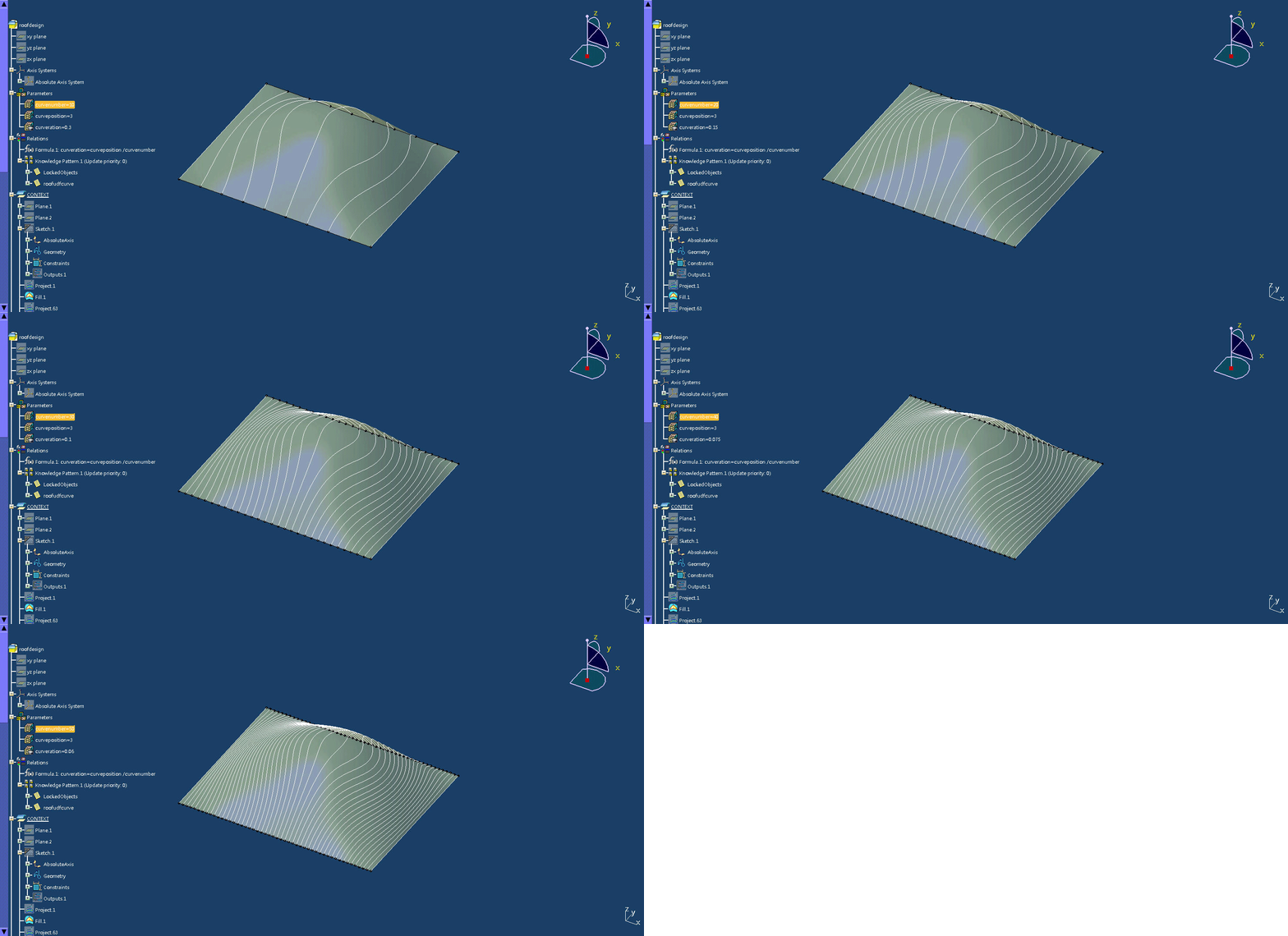
The line connecting same ratio points on the top and bottom edge of the surface is projected onto the surface, producing a framework for future overlay. The number of curves is manually controlled to achieve expected density.


 The surface is controlled by boundary line and the passing point


The top and bottom lines can also be isolated from the surface and be controlled separately, creating a potential muli-sections surface. Therefore, the performing curves can be interpreted as the dialog between the the fill surface and the multi-sections surface.

Project008 Powercopy Knowledgeware


The vertical curve is the only input while making powercopies of those pipes. 

The color of each pipe is controlled by the pipe's surface area. While the global parameters are the factor controlling the multiplicity of the pipe length and the color cutoff area, the local parameters are the random ratio of point on the curve and the random rotation angle range. Consequently, two separate excel sheet is set in order to generate the random numbers, thus they are able to behave independently. 

length factor

random position along the curve

control of random rotation angle range
The problem is that the diameter of the pipe profile and the length of the pipe is supposed to reflect the distance between the projection of the origin point on normal plane and the point on curve, but when I change the curve, the length of the pipe became so exaggerated. A new formula relationship between curve and pipe figure would be productive.